Relevant to the recent discussions around Do You WANT an LMS? Does a Learner WANT an LMS? and the possibility that we could soon be seeing something that looks more like a Wiki+Tracking capability, I just saw the news: Vignette Provides Online, On-Demand Training For Customers. They've added tracking and SCORM to their CMS solution. So, maybe my previous comments about this being a couple years away may have been too conservative.
Keywords: eLearning Trends
Monday, 31 July 2006

Friday, 28 July 2006
Where are open source learning applications?
Good post by Harold Jarche - Where are open source learning applications? In it he points to the learning space and says that the current status of open-source learning applications is:
Keywords: eLearning Trends
- Innovators - Elgg Learning Landscape and several others
- Early Adopters - Moodle and a few others
- Early Majority - nobody
- Late Majority - forget about it
I would tend to agree with him that there are relatively few open-source learning applications, but would add a few thoughts...
First, open-source generally succeeds once an application domain is fairly well understood and the feature sets are relatively more stable. If you look at the slow creep up the application stack of open-source solutions (OS, app server, database, CRM), then its easy to see the pattern. So, we should naturally expect to see open source solutions emerge where we see relatively stable feature sets.
Second, while for my corporate clients I wouldn't recommend any open source solutions today, I'm only avoiding it because it's probably worth the $ savings in the time you would lose dealing with a tool that is not quite as robust. In other words, the cost of Captivate is less than the lost time dealing with Wink. I do think it's worth keeping an eye on:
* Virtual classroom solutions - after having gone through trying to find inexpensive solutions, there's real opportunity here for Skype+conferencing. A few early tools exist, but they are in the early adopter stage.
* Demo + Audio recording solution - Wink is early adopter stage as well, but will soon be moving more mainstream. Think of it as freeware Captivate.
* Fun Interactions - Hot Potato
* Audio Editing - Audacity
and I know there's some that do essentially PPT + audio, lots of ways to create podcasts, video, and the list goes on.
Finally, I'm not really sure that asking about open source right now is as relevant as asking about free software as a service (SaaS) models. Having used surveymonkey, blogger, pbwiki and other tools quite a bit - it's even better than open source and even less expensive (open source you need time/dollars to get it up and going). While I wouldn't recommend open-source solutions today - unless you really, really don't value your time over dollar expenditure, I would recommend using SaaS solutions.
Keywords: eLearning Trends
Thursday, 27 July 2006
Does the discussion/debate do any good?
I just saw a great comment from Mark Oehlert around my post: Informal Learning - Harold Tells Us Where To Put It - Now What. In the comment he says relative to discussing Informal Learning:
This comment really struck me, because one of the questions that I struggle with all the time is whether spending time speaking/writing/talking about these issues does any good?
If you've attended Training, Performance, eLearning conferences over the past 10 years, I'm sure you've had the same experience of seeing the same presentations year-after-year. Many of them talk about:
So, while some of the speakers talk about new approaches (e.g., Marc Rosenberg - Rosenberg's Beyond eLearning - Is that eLearning 2.0?) the reality is that 98% of attendees are going to go home and do the exact same stuff as before.
So, I seriously question Mark's statement:
P.S. Can I just say that I love this debate and think that it is serving our
industry well and that we need more of this and we need it at conferences, up on
stage in front of thousands of people.
This comment really struck me, because one of the questions that I struggle with all the time is whether spending time speaking/writing/talking about these issues does any good?
If you've attended Training, Performance, eLearning conferences over the past 10 years, I'm sure you've had the same experience of seeing the same presentations year-after-year. Many of them talk about:
- We need to focus on business outcomes and performance - not butts in seats.
- We need to look beyond training to other kinds of interventions.
So, while some of the speakers talk about new approaches (e.g., Marc Rosenberg - Rosenberg's Beyond eLearning - Is that eLearning 2.0?) the reality is that 98% of attendees are going to go home and do the exact same stuff as before.
So, I seriously question Mark's statement:
- Do we need people talking about this at conferences?
- Does it do any good?
- What can we do to have greater impact on the practice of learning (as opposed to the rhetoric)?
Wednesday, 26 July 2006
Do You WANT an LMS? Does a Learner WANT an LMS?
I should be working on content for my presentations at DevLearn in October that look at what's next in eLearning. (As a side note: if you are going to DevLearn and are reading this, please drop me a note.) However, the "what's next" question has become more challenging recently as we've seen the rapid growth of simple and easy to deploy tools displacing more complex systems. My last post, Direction of eLearning - Emergence or Big System, received a couple of interesting comments and I wanted to add a couple of follow-up thoughts.
On Creating Passionate Users they had a great picture that captures how many of us feel about LMS products:
On Creating Passionate Users they had a great picture that captures how many of us feel about LMS products:
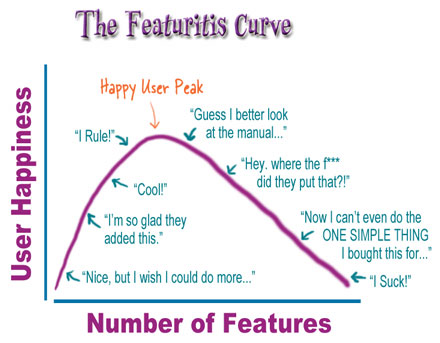 As the number of features increases our satisfaction level begins to go down because of the complexity of getting it to work for us.
What often happens when systems become very complex is that they begin to get replaced by simpler systems. This is exactly what's happened in the Content Management space. Wiki's have exploded onto the scene. They only do about 10% of what a typical CMS will do for you. But, they are so dang easy to get going and use. So, they've supplanted the low-end of the market. It forces the CMS products to seek ever higher features to continue to differentiate - a vicious cycle.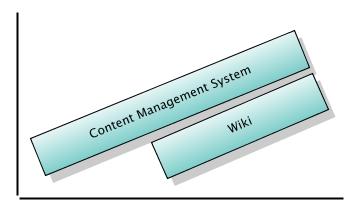 I believe we are poised to see this happen in the world of the Learning Management Systems (LMS). They are rapidly growing features that are far beyond what anyone needs. If you look at what's going on at Saba, SumTotal or any of the major players, they are adding features and major functional areas at an amazing pace. There are definitely some low-end LMS products that are easy to get up and going. But that's not really what's going to replace the LMS. They still require you to think and act in terms of "course" and "training" which is slowly becoming the wrong way to think.
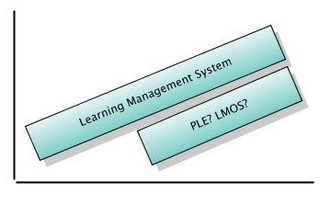
Of course, this raises the question - well if we don't really want an LMS, then what's the replacement?
Scott Bradley Wilson helped by providing a post with more detailed visualization of this.
I think that folks who are in the Personal Learning Environment (PLE) space have a much better idea of what will come next. In fact, many of us have all created our own Personal Learning Environment by cobbling together using a variety of tools (RSS Reader, Bookmarking, Social Networking, Desktop Search, Web Search, Personal Learning Blog, To Do Lists). I'm not 100% sure that we've quite got this right, but it's certainly much more meaningful to me as a learner than an LMS.
If you step back and take the perspective of a learner, an LMS is simply one of many content sources and there is no advantage to me as a learner of having to go through and register for the course (except that I won't get bugged about not completing the course). The tracking is not for me as a learner.
That's what makes me think that something more along the lines of a PLE will begin to come together to replace it.
However, I remain skeptical that we really understand how to use these tools to be better learners and thus, are a bit away from having well-formed personal learning environments. In fact, I believe this to be one of the bigger questions that we face as an community.
Tuesday, 25 July 2006
Direction of eLearning - Emergence or Big System
I ran across a post by Dave Boggs - More Standards In e-Learning?.... that pointed me to some presentations at alt-i 2 -lab 2006 that look at where the eLearning interoperability standards are going in the future. This is an interesting topic because it highlights a schism that is echoed in the larger world of IT: Enterprise IT (Big Systems) vs. Emergence (see Enterprise 2.0 and emergence).
The idea of Emergence is somewhat simple. You put out small, flexible, relatively easy to use systems and you see what results. The best analogy that sticks in my mind is building a new school and not paving paths between buildings. Rather, you wait to see the dirt paths that emerge based on where people walk. Then you pave those paths.
Enterprise IT on the other hand, attempts to provide significant support for processes and business rules. A great example is accessing an eLearning course. Most LMS products (out-of-the-box) require you to search, register and then launch the course. If you want the content to be searchable through your Intranet search mechanism, most LMS products get in your way (even though the content may be easily indexed by the search mechanism).
When I looked through the discussion around the next generation of standards, it made my head spin. There are many overlapping product sets (virtual classroom, LMS, LCMS, Authoring, Assessment, Search, Collaboration, HRIS, Talent Management, etc.), standards and new technologies allowing them to interoperate (SOA, Web Services, REST). Further, the standards are becoming much more complicated to support richer kinds of interoperability. It makes you yearn for the days of SCORM 1.1 where there was pretty much an LMS that needed to talk to courses.
In many corporate environments, I'm already seeing the pendulum swinging away from Enterprise IT. Sure, we'll stick the compliance training and formal training kinds of things under the LMS. But, a lot of content and tools are now not under the LMS. It's accessible through the Intranet. We cobble these together from smaller, cheaper, lighterweight solutions such as Reference Hybrids
It would be great if the LMS could help us by tracking this, but instead, we end up using other tracking mechanisms.
It continues to feel like LMS Products are Two Generations Behind and that they are going to continue to make it such that Leading with an LMS - Harmful to Your Health (or Skipping Stages in Bersin's Four Stage Model).
Keywords: eLearning Trends
The idea of Emergence is somewhat simple. You put out small, flexible, relatively easy to use systems and you see what results. The best analogy that sticks in my mind is building a new school and not paving paths between buildings. Rather, you wait to see the dirt paths that emerge based on where people walk. Then you pave those paths.
Enterprise IT on the other hand, attempts to provide significant support for processes and business rules. A great example is accessing an eLearning course. Most LMS products (out-of-the-box) require you to search, register and then launch the course. If you want the content to be searchable through your Intranet search mechanism, most LMS products get in your way (even though the content may be easily indexed by the search mechanism).
When I looked through the discussion around the next generation of standards, it made my head spin. There are many overlapping product sets (virtual classroom, LMS, LCMS, Authoring, Assessment, Search, Collaboration, HRIS, Talent Management, etc.), standards and new technologies allowing them to interoperate (SOA, Web Services, REST). Further, the standards are becoming much more complicated to support richer kinds of interoperability. It makes you yearn for the days of SCORM 1.1 where there was pretty much an LMS that needed to talk to courses.
In many corporate environments, I'm already seeing the pendulum swinging away from Enterprise IT. Sure, we'll stick the compliance training and formal training kinds of things under the LMS. But, a lot of content and tools are now not under the LMS. It's accessible through the Intranet. We cobble these together from smaller, cheaper, lighterweight solutions such as Reference Hybrids
It would be great if the LMS could help us by tracking this, but instead, we end up using other tracking mechanisms.
It continues to feel like LMS Products are Two Generations Behind and that they are going to continue to make it such that Leading with an LMS - Harmful to Your Health (or Skipping Stages in Bersin's Four Stage Model).
Keywords: eLearning Trends
Monday, 24 July 2006
Informal Learning - Let's Get Real - Part II
I've received quite a bit of input on my blog post Informal Learning - Let's Get Real. I feel like many of us are in the same boat. We want to figure out what the process and mechanisms should look like when we are going after Intentional Informal Learning. Interestingly, Stephen Downes' new presentation - e-Learning 2.0 - Why the New Tools includes a slide that quotes my blog post:
At first I was surprised, because Stephen is more of the "free range" approach, but once I listened to the presenation, I realized he was using my quote as a counter-example to comment about how wrong I am. Stephen's counter arguments are roughly that (a) informal learning happens all the time "so we know it works", (b) it depends on how you define "works", and (c) if your definition of "works" is that people learn what you want them to learn then you have defined it wrong.
The good news is that it actually helps in clarifying my thinking (and our differences).
Let's me define "works" for most of my projects - changes human performance in a way that achieves desired business outcomes. For example, changes how store managers work with front-line employees in order to improve customer satisfaction scores.
If I look at what I do, I often start by breaking the problem up into Intermediate Factors (see also - Elves, Measuring Results and Informal Learning). In this example, an important factor might be Knowldge of Store Layout. And when you take a look at that factor you realize that the performance in question is really all about how the front-line employee answers a particular kind of question - "Where do I find X?" Unfortunately, there's a lot rolled up into being good at answering this question (product knowledge - what is that thing, store layout knowledge, how you answer questions, helping store managers instruct and work with front-line employees). And there are many, many ways that we could use to help the store manager help the front-line employee improve their performance here.
The answer to whether it works is quite scientific, has our customer satisfaction score improved on that question (in stores where the numbers were down).
So, while our solution allowed for limited bottom-up content creation (best practices capture), this was controlled and closely monitored against metrics - certainly not "free range." I'm not sure that I buy that we would have had nearly the same effectiveness by providing a more open environment. I think the initial seeding of best practices, the on-going follow-up and the control structure we put on top of this system where critical to driving the numbers at the end of the day.
Finally, back to Stephen Downes' comment that if you define "works" as "learning what you want them to learn" ... Well I didn't define it that way, but it was awfully important at the end of the day for the managers to learn certain things about how to affect positive change around the numbers and important to help the managers help employees improve their performance. Maybe it's the difference between corporate environments and academic environments, but I think there's more to it than defining "works" ... there's a fundamental difference in eLearning 2.0: Informal Learning, Communities, Bottom-up vs. Top-Down.
Keywords: eLearning Trends, eLearning 2.0, Web 2.0, Informal Learning, Collaborative Learning
I'm becoming convinced that folks in the informal learning realm are quite
willing to live with "free range" learning. It's way too touchy-feely and
abstract for me. If this stuff is important, then I want to:
- Know that it will work
- Know why it works
- Know that its repeatable
At first I was surprised, because Stephen is more of the "free range" approach, but once I listened to the presenation, I realized he was using my quote as a counter-example to comment about how wrong I am. Stephen's counter arguments are roughly that (a) informal learning happens all the time "so we know it works", (b) it depends on how you define "works", and (c) if your definition of "works" is that people learn what you want them to learn then you have defined it wrong.
The good news is that it actually helps in clarifying my thinking (and our differences).
Let's me define "works" for most of my projects - changes human performance in a way that achieves desired business outcomes. For example, changes how store managers work with front-line employees in order to improve customer satisfaction scores.
If I look at what I do, I often start by breaking the problem up into Intermediate Factors (see also - Elves, Measuring Results and Informal Learning). In this example, an important factor might be Knowldge of Store Layout. And when you take a look at that factor you realize that the performance in question is really all about how the front-line employee answers a particular kind of question - "Where do I find X?" Unfortunately, there's a lot rolled up into being good at answering this question (product knowledge - what is that thing, store layout knowledge, how you answer questions, helping store managers instruct and work with front-line employees). And there are many, many ways that we could use to help the store manager help the front-line employee improve their performance here.
The answer to whether it works is quite scientific, has our customer satisfaction score improved on that question (in stores where the numbers were down).
So, while our solution allowed for limited bottom-up content creation (best practices capture), this was controlled and closely monitored against metrics - certainly not "free range." I'm not sure that I buy that we would have had nearly the same effectiveness by providing a more open environment. I think the initial seeding of best practices, the on-going follow-up and the control structure we put on top of this system where critical to driving the numbers at the end of the day.
Finally, back to Stephen Downes' comment that if you define "works" as "learning what you want them to learn" ... Well I didn't define it that way, but it was awfully important at the end of the day for the managers to learn certain things about how to affect positive change around the numbers and important to help the managers help employees improve their performance. Maybe it's the difference between corporate environments and academic environments, but I think there's more to it than defining "works" ... there's a fundamental difference in eLearning 2.0: Informal Learning, Communities, Bottom-up vs. Top-Down.
Keywords: eLearning Trends, eLearning 2.0, Web 2.0, Informal Learning, Collaborative Learning
Wednesday, 19 July 2006
Dashboards - Performance Intervention Opportunity
Found this via a post on Column Two - Productive dashboards. Definitely worth a read since we've been seeing this trend as well and there is a definite opportunity to tie performance interventions to dashboards. The approach we've used with various clients is to tie each KPI to a set of performance suggestions, learning opportunities, etc. In some cases these are static lists, in other cases these are composed into action plans that must be approved.
The beauty of the Action Plan approach is that we can then do follow-up (based on the dates in the Action Plan) to ensure that the plan is worked. We have also been able to track the effectiveness of each performance suggestion based on the delta in the KPI after the plan is worked. It definitely surprised us what worked and what didn't in some cases. We pulled down stuff that didn't work and created more interventions using approaches that did work.
The end result of this kind of process is that you are able to impact performance that has a tangible effect on numbers in the dashboard. These have been my favorite projects!
The beauty of the Action Plan approach is that we can then do follow-up (based on the dates in the Action Plan) to ensure that the plan is worked. We have also been able to track the effectiveness of each performance suggestion based on the delta in the KPI after the plan is worked. It definitely surprised us what worked and what didn't in some cases. We pulled down stuff that didn't work and created more interventions using approaches that did work.
The end result of this kind of process is that you are able to impact performance that has a tangible effect on numbers in the dashboard. These have been my favorite projects!
Subscribe to:
Posts (Atom)

